Three in Thirteen: The Story of a Mosquito Night Fighter Ace by Roger Dunsford & Geoff Coughlin
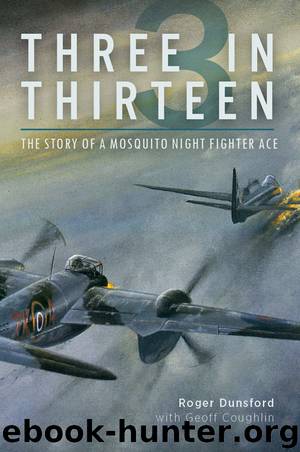
Author:Roger Dunsford & Geoff Coughlin [Dunsford, Roger]
Language: eng
Format: azw3
Publisher: Casemate
Published: 2017-04-19T04:00:00+00:00
6.
Enter the Mossie
(1st October 1942–8th April 1943)
The Mosquito
In January 1943, Hermann Goering is alleged to have said to his staff:
In 1940, I could at least fly as far as Glasgow in most of my aircraft, but not now! It makes me furious when I see the Mosquito. I turn green and yellow with envy. The British, who can afford aluminium better than we can, knock together a beautiful wooden aircraft that every piano factory over there is building, and they give it a speed which they have now increased yet again. What do you make of that? There is nothing the British do not have. They have the geniuses and we have the nincompoops. After the war is over I’m going to buy a British radio set – then at least I’ll own something that has always worked.1
Like the Defiant, Blenheim and Beaufighter, the last thing their designers had in mind when developing the Mosquito was night fighting. In the frenetic build-up of the RAF during the mid-1930s, Geoffrey de Havilland envisaged a twin-engined light (up to about 1000 lb bomb load) bomber with a range of about 1500 miles, which would be fast enough to out-pace any fighter of the day. His thinking was that, if this bomber could get away from anything chasing it, then it did not need heavy defensive armour or gun turrets to slow it down aerodynamically. Furthermore, he believed that such a bomber could be made from wood that was in plentiful supply, rather than aluminium or steel for the structural strength. Thus, it would have a much greater power-to-weight ratio and it would make far fewer calls on the hard-pressed supplies of strategic materials. Whilst acknowledging these advantages, the Air Ministry were decidedly lukewarm to the concept of a light bomber, embedded as they were in the doctrine of unescorted bombers with much heavier payloads and self-defences, despite the consequent loss of speed. De Havilland nevertheless persevered and in 1940 got clearance to proceed with the development of the Mosquito, more with a view to its potential use as a high-flying photoreconnaissance platform than as a bomber. Despite development being interrupted during the Battle of Britain, in order that de Havilland factories could devote all their capacity to supporting day fighter and training aircraft production, prototypes2 began flying in late 1940. With the need for night fighters becoming ever more apparent, it was soon recognised that the Mosquito was large enough to be fitted with an AI. In addition, its speed, range and agility would make it a much more capable replacement for the Beaufighter. So, by little more than happenstance, these two aircraft would form the mainstay of the RAF’s night-fighting capability for the entire war, despite neither having been intended for that purpose.
157 Squadron at Castle Camps near Cambridge was the first squadron to receive the Mosquito modified for night fighting (designated NF II) as early as December 1941. After another abortive attempt to use them as Turbinlight aircraft, they were
Download
This site does not store any files on its server. We only index and link to content provided by other sites. Please contact the content providers to delete copyright contents if any and email us, we'll remove relevant links or contents immediately.
| Africa | Americas |
| Arctic & Antarctica | Asia |
| Australia & Oceania | Europe |
| Middle East | Russia |
| United States | World |
| Ancient Civilizations | Military |
| Historical Study & Educational Resources |
The Radium Girls by Kate Moore(12117)
100 Deadly Skills by Clint Emerson(4984)
Rise and Kill First by Ronen Bergman(4857)
The Templars by Dan Jones(4751)
The Doomsday Machine by Daniel Ellsberg(4577)
The Rape of Nanking by Iris Chang(4276)
Killing England by Bill O'Reilly(4065)
Stalin by Stephen Kotkin(4025)
Hitler in Los Angeles by Steven J. Ross(3993)
12 Strong by Doug Stanton(3590)
Hitler's Monsters by Eric Kurlander(3412)
The Code Book by Simon Singh(3269)
Blood and Sand by Alex Von Tunzelmann(3256)
Darkest Hour by Anthony McCarten(3184)
The Art of War Visualized by Jessica Hagy(3058)
Hitler's Flying Saucers: A Guide to German Flying Discs of the Second World War by Stevens Henry(2785)
Babylon's Ark by Lawrence Anthony(2744)
Tobruk by Peter Fitzsimons(2575)
The Second World Wars by Victor Davis Hanson(2559)
